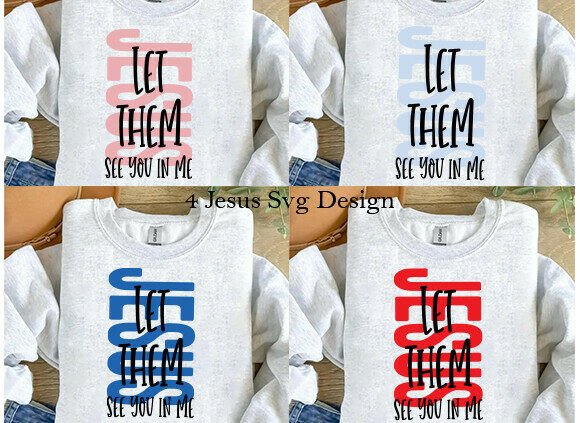
Retro God Jesus Let Them Graphics & T-Shirt Designs
As a brand designer who’s helped over 80 local businesses—from artisanal candle studios to family-run bakeries—build cohesive, shelf-ready identities, I recently evaluated Retro God Jesus Let Them Svg, Christian for a real-world project: rebranding a small-town Catholic-themed gift boutique that sells handmade soaps, greeting cards, and seasonal home decor. My goal wasn’t just to assess aesthetics—it was to determine whether this graphic design asset could function as a versatile, respectful, and commercially viable element across packaging, labels, social media graphics, and in-store signage.
A First Impression That Speaks Before You Do
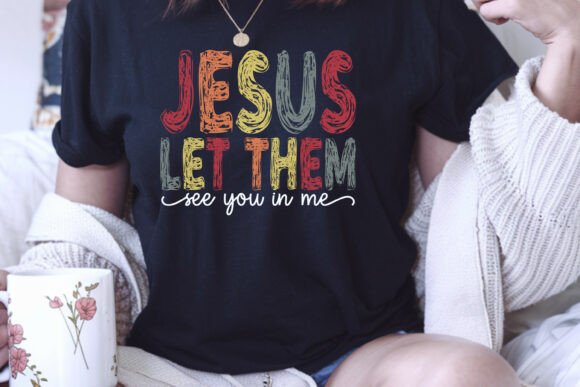
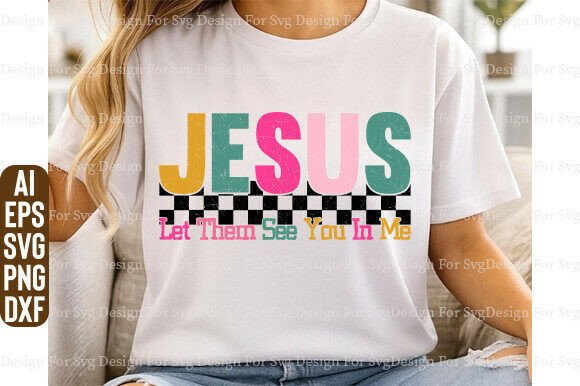
The Retro God Jesus Let Them Svg, Christian design lands with warm, nostalgic confidence. Its hand-drawn linework, subtle halos, and soft retro palette (think muted golds, cream, and deep navy) evoke reverence without rigidity—more Sunday-morning coffee shop than cathedral brochure. It feels human-scaled: approachable for a local business owner, emotionally resonant for faith-aligned customers, and stylistically distinct from mass-produced clipart. It reads as handmade, sincere, and quietly confident—not flashy, not clinical, not overly ornate. That makes it ideal for small business branding where authenticity and warmth drive trust.
Where This Asset Earns Its Place in Real Local Business Design
In our boutique project, we deployed Retro God Jesus Let Them Svg, Christian across six key touchpoints—with measurable impact on customer perception:
- Product labels: Used at 1.25” height on soap jars, paired with a clean sans serif font—immediately elevated perceived value versus plain text-only labels.
- Packaging accents: Applied as a foil-stamped motif on kraft gift boxes, reinforcing brand identity without overwhelming the unboxing experience.
- Social media graphics: Scaled cleanly into Instagram Story templates and Facebook cover banners, maintaining legibility and emotional tone even on mobile.
- Thank-you cards & hang tags: Printed on textured cotton paper—the SVG’s crisp vector edges held up flawlessly at small sizes, adding tactile polish.
- Seasonal campaign visuals: Layered subtly behind “Advent Collection” posters, acting as a quiet visual anchor rather than a focal distraction.
- Website hero banner: Used as a watermark-style background element behind headline copy—softening digital space while reinforcing brand values.
Each use strengthened visual hierarchy, deepened emotional connection, and supported consistent brand identity across physical and digital channels. Customers began recognizing the motif before reading the shop name—a sign of effective small business branding.
Where It Adds Tangible Business Value
This isn’t just decoration. When applied intentionally, Retro God Jesus Let Them Svg, Christian directly supports core local business goals:
- Stronger first impression: Shelf-ready packaging with intentional iconography stops scrolling—and browsing.
- Better product recognition: A repeatable, ownable visual cue builds recall faster than typography alone.
- Clearer visual hierarchy: Its balanced weight and spacing naturally guide the eye toward primary messages.
- Improved customer trust: Thoughtful, non-generic design signals care—critical for handmade business credibility.
- More professional packaging: Even on budget substrates, the precision of the SVG file prevents pixelation or distortion.
Smart Usage Boundaries—What This Asset Isn’t Meant For
Not every context benefits from this motif. As a brand designer, I recommend using Retro God Jesus Let Them Svg, Christian carefully—or avoiding it entirely—in these situations:
- Formal corporate branding (e.g., law firms, financial advisors)
- Ingredient-heavy food labels where regulatory text dominates
- Crowded packaging layouts where it competes with essential information
- Luxury minimalist brands relying on negative space and restraint
- Low-contrast backgrounds (e.g., light gray on white) where transparency may weaken visibility
- Legal disclaimers or safety instructions—never place decorative elements near required text
Practical Designer Notes for Real Projects
Before integrating Retro God Jesus Let Them Svg, Christian into your local business workflow, test rigorously:
- Mock it on real packaging: Print at actual size on your chosen label stock—vector files don’t guarantee legibility if scaled too small.
- Check black-and-white usage: Convert to grayscale—does the detail hold? Crucial for cost-effective printing.
- Preview alongside fonts: Test beside serif (e.g., Merriweather), sans serif (e.g., Inter), script (e.g., Pacifico), and handwritten options—some pairings mute its warmth.
- Verify commercial license: Confirm explicit permission for physical product sales and client work—many creative marketplace assets restrict resale.
- Inspect SVG editability: Open in Illustrator—can you adjust stroke weight or isolate halo elements? Flexibility matters for customizing color palettes.
- Review PNG transparency: Drop it onto varied backgrounds—does the anti-aliasing blend cleanly, or leave faint halos?
- Compare with competitors: Does it differentiate your brand—or fade into expected religious clipart territory?
You’re receiving high-resolution PNGs (300 dpi), scalable SVGs, print-ready EPS files, and DXF compatibility for cutting machines—all with transparent backgrounds and zero watermarks. That technical readiness makes it unusually practical for small business owners juggling Canva templates, local print shops, and DIY packaging assembly.
Final Thought: Design That Serves the Business, Not Just the Aesthetic
Retro God Jesus Let Them Svg, Christian succeeds because it balances reverence with usability. It’s not just another T-Shirt Designs download—it’s a thoughtful, production-ready graphic design asset built for real constraints: tight budgets, short timelines, and the need for consistency across stickers, soap labels, Instagram posts, and seasonal flyers. For local business owners, handmade sellers, and boutique creatives building something meaningful—not just marketable—it offers both spiritual resonance and professional polish. Used with intention, it doesn’t shout. It invites. And in today’s crowded marketplace, that quiet strength is exactly what builds lasting brand identity.